 Digital Workforce
 Too little core
It relearns everything, everywhere. Every install is the first install, and nothing compounds across customers.
The long version
Not a business school, not a bootcamp, and not the 2023 gold rush. A biology degree, one bioinformatics class, six years inside enterprises where a wrong model costs real money, and every year since building AI that people actually use on a Tuesday.

The short version
The market is filling up with business people learning AI. I went the other way — a data and engineering person who then spent years learning how businesses actually operate. Both routes reach the same job title. They do not produce the same instincts.
I have always had a knack for going outside the box. A move from Bangladesh to Houston. A biology degree that turned into code. A semester of school on a ship. Seventy-odd countries since. That is not restlessness — it is the same instinct that makes me distrust any system that has only ever seen one company.
LLMs and agents are brilliant inside the box. True learning happens in real-world friction.
That is the whole thesis. A model can be enormously capable and still have no idea what happens on a Tuesday in your business — who overrides what, which rule has three exceptions, what the customer actually meant. The frontier isn’t a better model. It is engineering the friction back in.
How I think about it
Seventy-odd countries in, you notice there are only two kinds. It took me years to realise I had been describing an architecture problem.
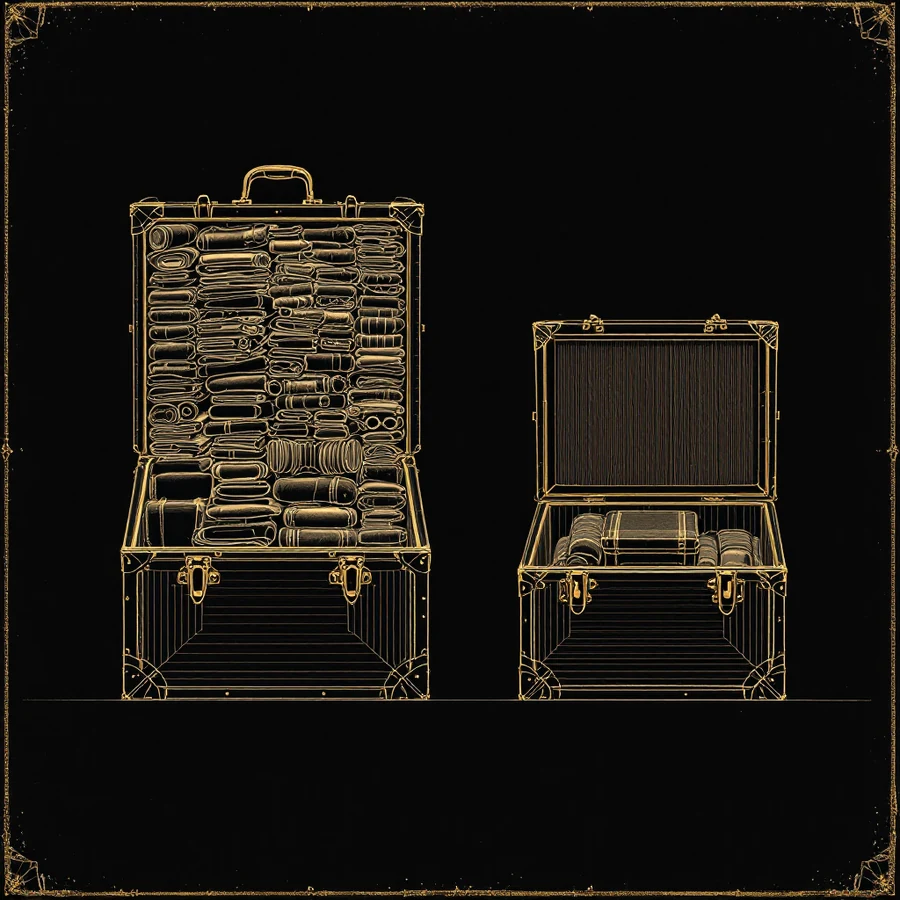
We are doing the first thing to AI. Bigger prompts, bigger context windows, more tools, more retrieved documents — then we send it into a business and wonder why it behaves like a tourist.
An agent can read the entire employee handbook and still have no idea what happens on Tuesday when the biggest customer calls and everyone quietly ignores page 47.
You learn page 47 by being there. That is the whole argument for embedding, and it is why a boundary appears in every system worth operating: what travels with it, and what it has to be taught on arrival.
It relearns everything, everywhere. Every install is the first install, and nothing compounds across customers.
It walks into Thailand looking for McDonald’s. The system insists on the one company it was shaped around, and calls every difference an exception.
Intelligence isn’t how much context you can carry. It is knowing what to carry, what to leave behind, and what the environment has to teach you.
We have made AI remarkably well-travelled. The work now is teaching it to live somewhere.
Where that boundary actually goes →The path
In order, with dates, and with what each one actually taught.

Chapter 01 · Bangladesh → Houston
I watch expats abroad recreate the environment they came from, and miss everything the new place could have taught them. It is the same failure mode as a species that specialises perfectly for ice. Moving countries taught me that adaptation is not random change — it is deliberately expanding the range of situations you can still function in.
Lesson: comfort and context are opposites. You only learn the shape of your own assumptions from outside them.

Chapter 02 · 2014 · Texas Southern University
I was studying living systems, not software. Then a senior bioinformatics class put code in front of genomic data and it found structure no one could see by eye. That was the hook — not the algorithm, but the fact that a system could hold more context than a person could.
Lesson: the interesting part was never the maths. It was what the maths could hold.

Chapter 03 · A semester at sea
I spent a semester studying aboard a ship. The coursework was fine. What actually taught me anything was the ports — the conversations, the markets, the arguments, the places where something I was certain about turned out to be true only where I came from. Education happens outside the school. Which is the same reason I think a model trained on everything can still be useless inside one particular business.
Lesson: your defaults are local. It is also, exactly, the core-versus-configuration judgment — learned years before I had a name for it.

Chapter 04 · 2016 · Indiana University Bloomington
Statistics, machine learning, and the unglamorous parts — data quality, experimental design, knowing when a result is real. This was before the transformer paper had left the lab, six years before ChatGPT, and long before anyone put “AI” in a job title to raise a round.
Lesson: rigor. And a working memory of several hype cycles arriving and receding.

Chapter 05 · 2017–2023 · Enterprise
Quote-pricing models at Total Safety. Retention pricing and customer-level profitability in residential energy at NRG. Credit-risk model validation for institutional banking clients at Affinity Risk, under formal model-risk-management review. Then Delta Faucet: an ML out-of-stock warning system across retail, trade and e-commerce, and causal-inference pricing experiments across multi-billion-dollar categories.
At that scale a bad model does not announce itself. It quietly costs money for two quarters and then somebody asks a question. You learn to build the checks before you build the thing — which is why evals, tracing and audit trails are not an afterthought in anything I ship now.
Lesson: rigor has a cost, and it is worth it.

Chapter 06 · Dec 2023 → now
I left the enterprise for service businesses — twenty-person operations where nothing is abstracted away and the person who sells is three desks from the person who delivers. Since December 2023 I have architected and operated agentic systems that connect models to private business data, CRMs, property-management systems and messaging platforms — including a multi-channel operations platform used daily by a property agency across 4,700+ live listings, on web, LINE and WhatsApp. Scoped permissions, approval gates, audit trails, retries, idempotency and per-request cost telemetry, because the alternative is a demo.
The part most people skip is the part I insist on: I stay and operate them. That is where you find out which clever ideas were actually clever, and which ones only worked because you were the one holding them.
Lesson: the model is one component. The system is the product.
What I hold to
Not values. Positions — each one costs me something, which is how you know it is real.
I don’t hand you a plan and leave. I stay through implementation and past it — operating the thing, watching real usage, fixing what breaks on a Tuesday. A plan nobody executes isn’t a plan. It’s a PDF.
A property brokerage’s AI needs are nothing like a clinic’s. I don’t arrive with a one-size framework — every system starts from how your business actually operates, including the exceptions nobody wrote down.
I won’t tell you AI can do something it can’t, or sell you a timeline I don’t believe. If the honest answer is “buy the off-the-shelf product” or “don’t build this”, that is what you’ll hear — including when it means we don’t work together.
The goal is never to automate a person out of the business. Consequential actions wait for someone until they have earned the right not to — and the handoff to a human is a feature of the workflow, not an admission it failed.
What production taught me
Education happens outside the school. It also happens outside the demo. These five cost me something before they became rules.
Own credential, least-privilege scope, never an engineer’s. Of 7,246 catalogued AI incidents, 188 caused direct harm with no attacker involved — a permission nobody meant to grant, an action nobody gated, a trail nobody could read.
Which parts of the work may be uncertain, agreed per business, on paper. On a system we operate, commission entering the picture forced that path deterministic — a number affecting someone’s pay has to be reproducible by a human, months later.
A deployment nobody opens is not a deployment. I instrument usage before accuracy: 94% that people trust beats 99% they route around.
Tracing, evals on your data rather than a public benchmark, per-request cost, version tracking, and a way back. Six enterprise years taught me a bad model doesn’t announce itself — it costs money quietly for two quarters. Agentic systems do it in a week.
A team kept an elaborate token-management system long after a 128k context window made it pointless. The hard part of adaptability isn’t learning. It’s deleting your own cleverness once it stops being true.
Why DWS exists
Most AI work fails on one side or the other. Either somebody understands the business and cannot build a system that survives production, or somebody can build anything and does not know which thing deserves to exist.
Let’s talk about your business
No commitment. No pressure. A free twenty-minute conversation where I look honestly at your operation and tell you exactly where AI fits — and where it doesn’t.
Or reach out directly: imtiazh@digitalworkforcesystem.com WhatsApp